Buy a quick change tool post at $94.59 before anything else; it removes the shim-and-realign ritual every stock tool post forces on every tool change, and every other upgrade below it builds on that.

Nakkaa 250-000 OXA Quick Change Tool Post Set For 6"-8" Lathe Swing
Check price on Amazon
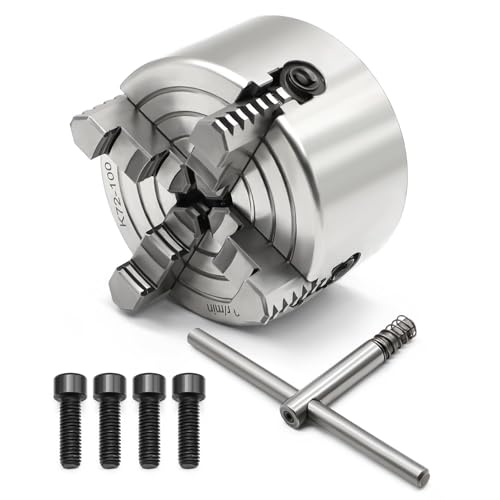
K72-100 Lathe Independent Chuck 4 Inch Manual Chuck 4 Jaw 3500 r/min
Check price on AmazonWhat order should mini lathe upgrades happen in?
Upgrade order matters because some tools unlock others. A quick change tool post makes it fast to swap between turning, facing, parting and boring tools, which matters far more once a 4-jaw chuck lets off-center and irregular work happen in the first place. A dial indicator is nearly useless without a 4-jaw to true work up in.
Resist the urge to buy everything from a single kit deal in the first week. A lathe purchased with a large bundled accessory package often ships with lower quality holders, chucks or measuring tools than the equivalent items bought separately once a specific need shows up, and money spent up front on parts that sit unused is money not available for the upgrade that would actually solve the problem in front of you.
- Quick change tool post, so tool changes take seconds instead of minutes of shimming.
- 4-jaw independent chuck, for off-center work, square stock and precise centering.
- Dial indicator with magnetic base, to true up work in the 4-jaw and check runout.
- A basic set of carbide turning tools sized to the tool post holders.
- Digital or dial caliper, if one was not already bought with the lathe itself.
- Digital readout (DRO), once cut depth and position tracking becomes the bottleneck.
Why is a quick change tool post the first purchase?
A stock single tool post on most mini lathes holds one tool at a fixed height, adjusted with shims. Switching from a turning tool to a facing tool or a parting blade means loosening, swapping, and re-shimming the height every time. A quick change tool post holds several tools in individual holders pre-set to center height, so changing tools is a lever release and a slide, not a five minute fuss with feeler gauges.
Sets like this typically include the post and several holders for $94.59, enough to keep a turning tool, a facing tool, a boring bar and a parting blade all ready at once. See best quick change tool post for options across lathe swing sizes.
What does a 4-jaw chuck add over the stock 3-jaw?
A 3-jaw chuck self-centers round stock automatically but cannot true up out-of-round bar, hold square stock precisely, or deliberately offset a part for eccentric turning. A 4-jaw independent chuck like the ASZLBYM 4 inch 4-jaw chuck at $54.99 moves each jaw independently, so a part can be dialed in dead true, or intentionally offset for cam and crank work.
The tradeoff is setup time: a 4-jaw takes a few minutes with a dial indicator to center a part, versus the instant grip of a 3-jaw. Keep both mounted and swap between them depending on the job. See how to indicate a part in a 4-jaw chuck for the process.
Buying a second backplate, sized to the specific lathe spindle, so the 4-jaw and 3-jaw can each stay permanently mounted to their own plate makes swapping between them a matter of a few bolts rather than fully disassembling and remounting a chuck body every time a job changes. It is a small added cost that pays off quickly once both chucks see regular use.
| Chuck type | Best for | Setup time |
|---|---|---|
| 3-jaw self-centering | Round stock, quick jobs | Seconds |
| 4-jaw independent | Square stock, offset work, true-up | A few minutes with an indicator |
Is a DRO worth the money on a mini lathe?
A digital readout removes the guesswork from tracking carriage and cross slide position, which matters most once parts need repeatable dimensions across multiple cuts. Kits like the CHAWED 2 axis DRO kit at $109.99 add glass or magnetic scales to the cross slide and carriage. It is a later upgrade, not a first one; dial indicators and careful use of the stock handwheel graduations get a beginner through most early projects.
The real benefit of a DRO shows up on parts that require returning to an exact position more than once, such as facing a shoulder to a specific length after removing and re-chucking a part, or cutting a step diameter that must match a print dimension precisely. Handwheel graduations work fine for a single continuous cut, but they accumulate backlash error every time direction is reversed, which a DRO reading directly off a linear scale does not suffer from.
What tooling actually fits a new quick change tool post?
Quick change tool posts use holders sized to the post, most commonly the OXA size for 6 to 8 inch swing lathes or AXA for slightly larger machines. Confirm the lathe swing before buying holders separately from the post, since an OXA holder will not clamp into an AXA post body.
Extra holders are worth buying beyond the set that ships with the post itself, since a holder left permanently set up for a boring bar or a parting blade means that tool is always ready without a height reset the next time it is needed. Most operators settle on four to six holders in regular rotation: a general turning tool, a facing tool, a parting blade, a boring bar, and often a threading tool once threading work becomes routine.
Does a collet set belong on the early upgrade list?
A collet set, most commonly ER32 sized for mini lathe spindles, holds round stock with less runout than a 3-jaw chuck and does it faster than truing work in a 4-jaw. The tradeoff is range: a single collet holds only one specific diameter, so a set spanning the common fractional or metric sizes is needed to cover general work, unlike a chuck that adjusts across a range with the same jaws.
Collets earn their keep on repeat small-diameter work, such as producing several identical bushings or shafts from the same size bar stock, where the improved grip accuracy and faster changeover pay for themselves quickly. For occasional one-off parts in mixed diameters, a 3-jaw and 4-jaw combination still covers more ground per dollar spent.
Shop the tools for this
An even spread across the price range, cheapest to premium.


Frequently asked questions
Should the quick change tool post or the 4-jaw chuck be bought first?
The tool post, generally, since it improves every single session at the lathe regardless of what is being turned. The 4-jaw chuck is essential once off-center or square stock work starts, but a beginner spends more early time turning round bar between centers or in the 3-jaw.
Do quick change tool posts fit every mini lathe?
No. They are sized by lathe swing, most commonly OXA for 6 to 8 inch swing machines and AXA for larger. Check the listing against the lathe specification before buying, since a mismatched post will not seat correctly on the compound.
How long does it take to true up work in a 4-jaw chuck?
A few minutes for a beginner using a dial indicator and the tap-and-check method, faster with practice. It is slower than a 3-jaw every time, which is why most shops keep both chucks on hand and swap based on the job.
Is a DRO a beginner purchase or a later one?
Later. New turners get more value from mastering the stock handwheel graduations and a dial indicator first. A DRO becomes worthwhile once repeatable multi-cut dimensions on precision parts become routine work.
What carbide inserts should go with a new tool post?
A basic set covering a general turning insert, a facing insert and a parting blade covers most early projects. See best lathe tool set for sets matched to common holder sizes.
Keep going
Researched from published specifications, standards and verified owner reviews. Not professional advice. How we research.