The Clockwise Tools DIMR-0105 Dial Indicator with Magnetic Base at $57.99 covers both jobs a home shop needs most: dialing in a 4-jaw chuck and checking runout, with a base strong enough to hold on a lathe bed or mill column.
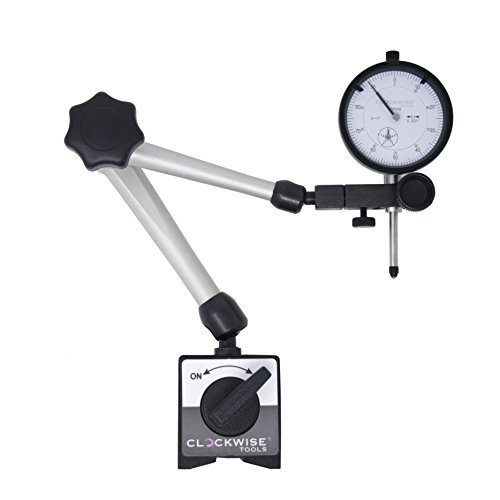
Clockwise Tools Dial Indicator with Magnetic Base Holder Stand
A plunger dial indicator paired with a magnetic base handles the two most common indicating jobs in a home shop: centering work in a 4-jaw chuck and checking spindle or part runout. The Clockwise Tools DIMR-0105 has a 0-1" range with 0.001" graduation, a magnetic base with a fine-adjustment arm for positioning the indicator precisely, and it comes from a brand with a track record among hobby machinists rather than an unbranded import.
Check price on AmazonThe three picks at a glance
| Tier | Pick | Price |
|---|---|---|
| Beginner | Dial Indicator with Magnetic Base | $29.89 |
| Intermediate | Clockwise Tools Dial Indicator with Magnetic Base Holder Stand | $57.99 |
| Expert | Mitutoyo 2416A Dial Indicator | $99.84 |
Beginner: Best first indicator set
Who it is for: A hobbyist setting up their first lathe who needs to indicate work in a 4-jaw chuck and has not owned a dial indicator before.

Dial Indicator with Magnetic Base
The Cupbunny Dial Indicator with Magnetic Base at $29.89 bundles a 0-1" plunger indicator, a magnetic base, and a 22-point point set in one package, everything needed to start indicating without buying pieces separately.
Check price on AmazonSkip it if: Anyone needing a lever-type dial test indicator for tight spaces near a chuck jaw.
Intermediate: Buy once
Who it is for: Someone indicating parts every session who wants a base with enough holding force and a fine-adjustment arm for repeatable setups.
Clockwise Tools Dial Indicator with Magnetic Base Holder Stand
The Clockwise Tools DIMR-0105 at $57.99 pairs a 0-1" 0.001" dial indicator with a magnetic base holder built for daily use, from a brand specifically known in the hobby machining community.
Check price on AmazonSkip it if: Anyone who wants a certified brand-name gauge with tighter published accuracy than a general-purpose combo set.
Expert: Performance ceiling
Who it is for: A machinist who wants a certified precision indicator and a separate premium magnetic stand for serious setup and inspection work.

Mitutoyo 2416A Dial Indicator
The Mitutoyo 2416A Dial Indicator at $99.84 has a stem-bush design for a longer clamping range, a rigid bearing plate that reduces tracing error, and high dust resistance, the kind of build quality that shows up in long-term repeatability.
Check price on AmazonSkip it if: Anyone who does not already own a separate quality magnetic base, since this is the indicator alone, not a bundled set.
Plunger dial indicator or dial test indicator: what is the difference?
A plunger dial indicator moves a straight spindle in and out and reads the full range on its face; it is the tool to check runout on a chuck or measure how far a part moves when tightened. A dial test indicator uses a small lever arm that swings a short arc, which reaches into tighter spaces, such as indicating close to chuck jaws, but reads a much smaller range, typically 0.03" or less.
Most home shops need a plunger indicator first for general runout checks, and add a dial test indicator once they start indicating parts in a 4-jaw chuck regularly. The full comparison is at dial indicator vs dial test indicator.
Do you need a separate magnetic base, or does a bundle work?
A bundled indicator-and-base set, like the Clockwise Tools DIMR-0105 or the Cupbunny combo, is the practical choice for a first purchase: the parts are matched and the price is lower than buying each separately. A separate premium indicator, like the Mitutoyo 2416A, only makes sense once you already own a base you trust and want to upgrade the indicator alone.
Whichever you buy, confirm the magnetic base has a fine-adjustment arm; without one, positioning the indicator precisely against a part takes far longer.
| Product | Type | Range | Price |
|---|---|---|---|
| Cupbunny Combo | Plunger + base | 0-1" | $29.89 |
| Clockwise Tools DIMR-0105 | Plunger + base | 0-1" | $57.99 |
| Shars Dial Test Indicator | Lever/test only | 0.03" | $46.05 |
| Mitutoyo 2416A | Plunger only | 0-1" | $99.84 |
How much magnetic base holding force is enough?
A magnetic base rated in the 90 to 130 pound range holds securely to a lathe bed or mill column for normal indicating work, and most hobby-grade bases fall in that range. What matters more day to day is the fine-adjustment arm, since a base that will not lock its position precisely wastes more time than one with marginally less holding force.
On or near a spinning chuck, keep the base and arm clear of the rotating work and never leave an indicator set up while the lathe is running unattended.
What ruins a dial indicator fastest?
Swarf and coolant working into the plunger mechanism cause sticking, which shows up as a needle that hesitates or does not return to zero cleanly. Dropping an indicator, even a short fall onto a bench, can bend the spindle or crack the crystal, and either problem is often not worth repairing on a budget indicator.
Wipe the plunger and store the indicator in its case between uses, and confirm the needle returns cleanly to zero before trusting a reading on an important part.
Also worth considering
- Shars .030" x .0005" Dial Test Indicator 303-3203 !] ($46.05): A Shars dial test indicator, the lever-type style that reaches into tight spots a plunger indicator cannot, for indicating close to chuck jaws.
- Fowler 52-520-199-0 ($81.79): A Fowler magnetic base and dial indicator set for a shop that wants a second complete kit at the mill.
- Mitutoyo 64PKA079 Magnetic Stand With Dial Indicator ($179.34): A Mitutoyo magnetic stand with a matched dial indicator, sold as a unit rather than a mix of brands.
- Mitutoyo 543-783B-12 Absolute Digimatic Indicator ID-S ($207.00): A Mitutoyo Absolute Digimatic Indicator for a digital readout instead of reading a dial face.
More options across the price range
Chosen as an even spread from the cheapest to the most expensive listing in this category.


How we chose
Every product here is drawn from the site catalog of currently listed Amazon products, chosen for published range, graduation, base holding force and brand reputation rather than any hands-on trial in a shop.
Bundled indicator-and-base combos are emphasized for beginner and intermediate buyers because they solve the whole job at once and remove the guesswork of matching a compatible base to an indicator, while certified single indicators from Mitutoyo are reserved for the expert tier, where the buyer typically already owns a base.
Buying tips
Plunger or lever style first?
Plunger first, for general runout checks; add a lever-type dial test indicator once you regularly indicate parts in a 4-jaw chuck.
Does the base need a fine-adjustment arm?
Yes. Without one, positioning the indicator precisely against a part takes noticeably longer and is harder to repeat.
Bundle or separate indicator and base?
Bundle for a first purchase; buy a separate premium indicator only once you already own a base you trust.
How do you protect an indicator day to day?
Store it in its case, wipe the plunger before use, and never leave it set up on a chuck that is running unattended.
Get these picks by email
Every item on this page with its current price in one email, so you can buy the shop in stages. No sales sequence.
Used only to send the list.Frequently asked questions
What is a dial indicator used for in a home shop?
A dial indicator measures small amounts of movement, most commonly checking runout on a chuck or spindle, indicating a part true in a 4-jaw chuck, or confirming a vise or fixture is aligned square to a mill table. It reads in thousandths of an inch and mounts on a magnetic base or a dedicated holder near the work.
Do I need both a plunger indicator and a dial test indicator?
Not immediately. A plunger indicator with a magnetic base handles most beginner and intermediate jobs. A dial test indicator becomes worthwhile once you regularly indicate parts in a 4-jaw chuck, since its lever arm reaches into tight spaces near the jaws that a plunger indicator cannot access.
How strong does a magnetic base need to be?
For a home lathe or mill, a base rated around 90 to 130 pounds of holding force is more than enough to stay put during normal indicating work. What matters more in daily use is a fine-adjustment arm that locks its position precisely, since a weak adjustment mechanism costs more time than a slightly lower holding force.
Why does a Mitutoyo dial indicator cost so much more than an import?
A Mitutoyo 2416A adds a stem-bush design for a longer clamping range, a rigid bearing plate that reduces tracing error, and high dust resistance, which together produce more consistent long-term repeatability than an unbranded import. The graduation and range are often the same on paper; the difference is in how the reading holds up over years of use.
Can a dial indicator go bad from being dropped once?
Yes. Even a short drop onto a bench can bend the spindle slightly or crack the crystal face, either of which makes the reading unreliable. Check that the needle returns cleanly to zero after any drop, and if it does not, the indicator should be replaced rather than trusted for precision work.
Keep going
Researched from published manufacturer specifications, listing details and verified owner reviews. Not hands-on testing and not professional advice. How we research.