Choose the ER32 collet set at $46.89 for a wide clamping range from one collet and easy use on both a lathe and a mill. Choose the 5C collet set at $54.25 if you want the tightest runout for repeat production work and a system with the biggest secondhand tooling market.
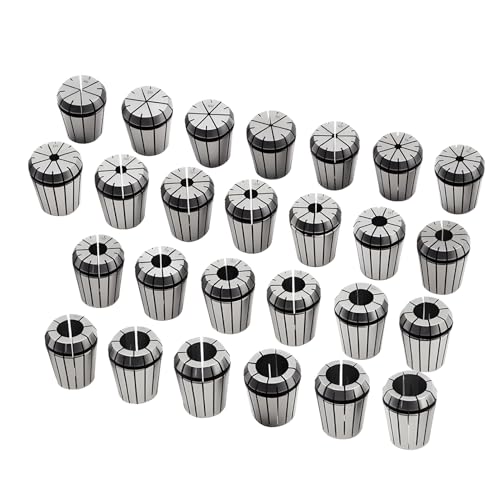
Yunnergo 26 Pcs ER32 Spring Collet Set 1/32"- 13/16"
Check price on AmazonThe two options side by side
Yunnergo 26 Pcs ER32 Spring Collet Set 1/32"- 13/16"
A 26-piece set spanning 1/32 to 13/16 inch. Each collet clamps a small range of diameters, spring-closing evenly around the stock, and the same collets work in lathe holders, mill holders and tool holders.
Check price on Amazon
HHIP 3900-0012 6 Piece 5C Collet Set
A 6-piece starter set covering 1/8 to 3/4 inch by eighths. Each collet fits exactly one size, giving very tight, repeatable runout, and 5C is the long-standing standard on lathes, collet blocks and indexing fixtures.
Check price on AmazonPick ER32 if you want one collet set that flexes across a wide size range and doubles as mill tooling. Pick 5C if you already have or plan to add a 5C collet chuck to your lathe, want the tightest runout for precision repeat work, or want access to the huge used tooling market that decades of industrial use have built around the 5C standard.
How do ER32 and 5C actually clamp differently?
An ER collet has a tapered outer surface that a nut compresses against a matching taper in the holder, and the slots cut into the collet let it close down evenly around stock anywhere within its rated clamping range, typically about a millimeter or two of spread per collet. A 5C collet also closes via a taper and a drawbar or lever, but each collet is sized for one specific stock diameter with almost no spread, which is the tradeoff that buys 5C its tighter runout.
In practice this means one ER32 collet handles a small range of bar sizes, while a 5C collet set needs a size that matches your stock closely, which is why 5C sets are sold in fine increments like eighths or sixteenths of an inch.
| Factor | ER32 | 5C |
|---|---|---|
| Clamping range per collet | Small spread, a couple mm | Fixed, one diameter each |
| Typical runout | Good | Excellent |
| Works on mill and lathe | Yes, same collets | Mostly lathe and dedicated fixtures |
| Set price for wide range | $46.89 | $54.25 |
Which system gives better runout for precision work?
5C collets generally hold tighter runout than ER collets because each 5C collet is ground for one specific diameter with minimal spring closure needed, while an ER collet has to flex across its clamping range and that flex introduces slightly more variation part to part. For repeat production runs where you are holding the same stock size over and over, a dedicated 5C collet in that exact size is the more repeatable choice.
For general hobby work where stock size varies project to project, ER32's wider range per collet usually outweighs the small runout advantage 5C offers.
Can I use ER32 or 5C on both my lathe and my mill?
ER collets were designed originally for milling and tool holding and have since spread into lathe collet chucks, so the same ER32 collet set can hold end mills in a mill and round stock in a lathe collet chuck, a real convenience for a shop running both machines. 5C collets are historically a lathe and fixturing standard, most common in 5C collet chucks, collet blocks for milling setups, and indexing fixtures, but they are less commonly found holding end mills directly.
If you own both a mini lathe and a mill and want one collet investment to serve both, ER32 is the more flexible starting point.
How much stock size flexibility do you actually get from each set?
This ER32 set spans 1/32 to 13/16 inch across its collets, and because each collet spreads slightly, you effectively get continuous coverage across that whole range rather than only fixed increments. This 5C starter set covers 1/8 to 3/4 inch but only in eighth-inch steps, meaning stock between those steps needs either a next-size-up collet with some slop or a dedicated collet in that exact size bought separately.
Larger 5C sets sold in sixteenths close that gap at a higher price, so factor the finer set into your budget if precise sizing across many diameters matters for your work.
What does it cost to get a collet system running on a lathe?
Neither collet set is useful on a lathe without a matching collet chuck or collet closer sized to your spindle nose, and that holder is often a larger expense than the collets themselves. Confirm your lathe's spindle thread or taper before buying a chuck, since a mismatch means the whole collet investment sits unused until you buy the correct adapter or a different chuck.
Once the chuck is sorted, both ER32 and 5C collets are relatively inexpensive to expand a set over time, buying individual sizes as specific projects call for stock diameters your starter set does not already cover.
Shop the tools for this
An even spread across the price range, cheapest to premium.


Frequently asked questions
Do ER32 collets work in a 5C collet chuck?
No, the two systems use different taper angles and closing mechanisms, so ER32 collets will not seat or clamp correctly in a 5C collet chuck or vice versa. You need a holder or chuck matched specifically to the collet system you choose, and mixing the two requires an adapter designed for that purpose rather than swapping collets directly.
Which collet system is better for a beginner mini lathe owner?
ER32 is generally the friendlier starting point for a beginner because one set of collets covers a wide range of common stock sizes and the same collets double as mill tooling if you add a mill later. 5C is a strong choice if your lathe already has a 5C spindle nose or you are buying a dedicated 5C collet chuck and want the tightest runout available.
Why do 5C collets only fit one exact diameter?
The 5C design achieves its tight runout by minimizing the amount of spring flex needed to clamp the stock, and a collet ground to close around exactly one diameter needs far less flex than one asked to span a range. That precision is the tradeoff for needing more individual collets to cover the same range an ER collet set covers with fewer pieces.
Can I hold square or hex stock in ER32 or 5C collets?
Standard round collets in both systems are made for round stock only, but both ER32 and 5C are available in square and hexagon collet variants sold separately for holding bar stock with flats. Check your specific job against the collet shapes actually included in a set before assuming round collets will grip square material safely.
How do I know what collet size to use for my stock?
Measure the actual stock diameter with a caliper or micrometer rather than trusting a nominal size marked on the bar, since real bar stock often runs a few thousandths under its labeled size. For ER collets, pick the collet whose range comfortably includes that measured diameter, and for 5C, pick the collet size that matches it as closely as possible.
Keep going
More comparisons
- 7x14 vs 8x16 mini lathe
- Carbide vs HSS lathe tools
- Digital vs dial caliper
- Caliper vs micrometer
- Dial indicator vs dial test indicator
- Portable bandsaw vs 4x6 horizontal bandsaw
- Spiral point vs hand taps
- Cobalt vs titanium drill bits
Researched from published specifications, standards and verified owner reviews. Not professional advice. How we research.