Drill the correct tap drill size, chamfer the hole edge, then cut threads with a spiral point or plug tap and cutting fluid like Forney Tap Magic at $11.40, backing off every half turn to break the chip.

Forney 20857 Tap Magic Industrial Pro Cutting Fluid
Check price on Amazon
80pcs Tap and Die Set
Check price on AmazonWhat is the 75 percent thread rule for tap drill size?
Cutting a full 100 percent depth thread makes tapping dramatically harder and gains almost no strength over a 75 percent thread, which is the standard target for hand and machine tapping. The rule: tap drill diameter equals the major diameter minus 1.299 divided by TPI, then multiplied by 0.75. For metric threads that simplifies to roughly the major diameter minus one pitch.
Rather than doing that arithmetic by hand every time, run the size through the tap drill calculator or look it up on the tap drill chart. Common sizes are also broken out at 1/4-20, #10-32, M6x1 and M8x1.25.
| Thread | TPI or pitch | Tap drill (approx) |
|---|---|---|
| 1/4-20 UNC | 20 TPI | #7 (0.201 in) |
| #10-32 UNF | 32 TPI | #21 (0.159 in) |
| M6x1.0 | 1.0mm pitch | 5.0mm |
| M8x1.25 | 1.25mm pitch | 6.8mm |
What is the step by step process for tapping a hole by hand?
Hand tapping rewards patience over force. Rushing a tap into cast iron or stainless steel is the single most common cause of a broken tap stuck in a workpiece.
- Center punch the hole location and drill a pilot hole with a center drill first if precision placement matters.
- Drill the tap drill size hole to the correct depth, using the tap drill calculator or chart for the thread being cut.
- Chamfer the hole edge with a deburring tool or countersink so the tap starts square instead of catching an edge burr.
- Apply cutting fluid to the tap and the hole before the first turn.
- Start the tap square to the surface, checking alignment from two angles before applying any downward pressure.
- Turn the tap forward about half a turn, then back off a quarter turn to break the chip, repeating this rhythm through the full depth.
- Reapply cutting fluid every few turns, especially in blind holes where chips pack tighter.
- Back the tap out fully once the required thread depth is reached, clearing chips with air or a brush before assembly.
Spiral point tap or straight flute tap: which one?
A spiral point (gun) tap pushes chips ahead of it, out the far side of the hole, which makes it the right choice for through holes. A straight flute tap or a spiral flute tap pulls chips up and out, which is what a blind hole needs since there is nowhere ahead for chips to go. Using the wrong style in a blind hole packs chips at the bottom and is a common cause of tap breakage.
A straight flute hand tap, the style most commonly included in general purpose tap and die sets, works reasonably in both through and blind holes if the operator backs off frequently enough to clear chips manually, though it is not as fast or forgiving as choosing the style matched to the hole. See spiral point vs hand taps for a fuller comparison.
A set like the KOOPOOL 80pc tap and die set at $46.99 covers both SAE and metric plug taps for general hobby use across a wide size range.
Why does cutting fluid matter so much for tapping?
Tapping removes material in a mostly enclosed space with no room for a coolant flood, so the fluid does two jobs: reducing friction that causes galling, and helping flush chips out of the flutes. A dedicated tapping fluid like Forney Tap Magic outperforms plain oil on stainless steel and aluminum, both of which gall and load up flutes more than mild steel.
A dry tap, run without any fluid at all, is one of the fastest ways to gall a hole in aluminum or stainless and either seize the tap mid-hole or leave a rough, oversized thread once it does come free. Even a light general purpose cutting oil applied before starting and reapplied every few turns makes a noticeable difference over running completely dry, and it costs far less than a broken tap or a ruined hole in an otherwise finished part.
What causes a broken tap, and how is one removed?
Broken taps almost always trace back to one of three causes: wrong tap drill size (too small, cutting too much material), no chip-breaking backoff motion, or forcing a tap that is not square to the hole. Prevention is far easier than extraction. If a tap does break, options range from a dedicated tap extractor to spark erosion at a machine shop for a tap broken flush in an expensive part.
Cast iron and stainless steel are the two materials most likely to snap a tap, for opposite reasons. Cast iron chips break short and dry, which sounds forgiving but hides how brittle the tap itself becomes under sideways load if it binds. Stainless work-hardens the instant a tap rubs instead of cutting, so any hesitation partway through a hole can turn the remaining depth into cutting through a harder skin than the tap started in. Both materials reward a slower pace and more frequent chip-breaking backoffs than mild steel or aluminum need.
What tap wrench should be used for hand tapping?
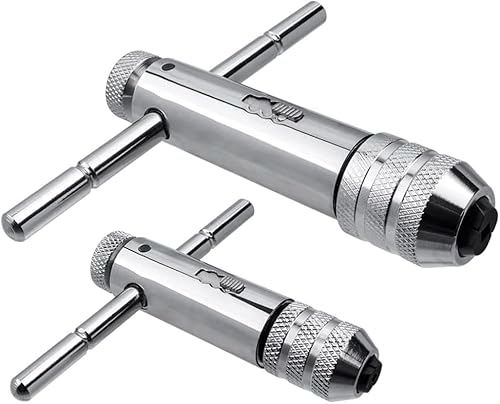
A T-handle tap wrench works well for smaller taps up through roughly 3/8 inch or M10, giving good feel for resistance through the fingertips without much mechanical advantage to accidentally overpower a small tap. Larger taps benefit from a two-handle tap wrench or a ratcheting handle, which spreads torque more evenly and reduces the chance of snapping a tap through an uneven grip.
A cheap adjustable T-handle wrench, sized to the tap being used, is one of the least expensive items in a tapping kit and one of the easiest to get wrong by using a wrench too large for a small tap, since the extra leverage makes it far easier to apply more torque than a small tap can handle before it snaps.
Shop the tools for this
An even spread across the price range, cheapest to premium.




Frequently asked questions
What tap drill size should be used for 1/4-20?
A number 7 drill (0.201 inch) is the standard tap drill for 1/4-20 UNC at roughly 75 percent thread engagement. Some references list 13/64 inch as an acceptable substitute where a number drill set is unavailable, though it cuts slightly less thread depth.
Why did my tap break inside the hole?
The three most common causes are an undersized tap drill leaving too much material to cut, skipping the forward-and-backoff motion that breaks chips, or forcing the tap when it is not started square. Slow down, back off every half turn, and confirm squareness before applying pressure.
Do I need cutting fluid for tapping aluminum?
Yes. Aluminum galls readily against a steel tap without lubrication, especially in blind holes where chips have nowhere to escape. A light cutting fluid or dedicated aluminum tapping fluid noticeably reduces galling and tap wear.
What is the difference between a plug tap and a bottoming tap?
A plug tap has a tapered lead of several threads, making it easier to start and suitable for through holes. A bottoming tap has almost no taper, cutting threads nearly to the bottom of a blind hole, but it is harder to start and normally used after a plug tap has already begun the thread.
Can a hand tap be used in a drill press or lathe for alignment?
Yes, a common technique is chucking the tap in a drill press or the lathe tailstock chuck without power, using the machine only to keep the tap square while turning it by hand with a wrench. This does not replace the forward-and-backoff cutting motion, which still must be done manually.
Keep going
Researched from published specifications, standards and verified owner reviews. Not professional advice. How we research.